


Why So Long?
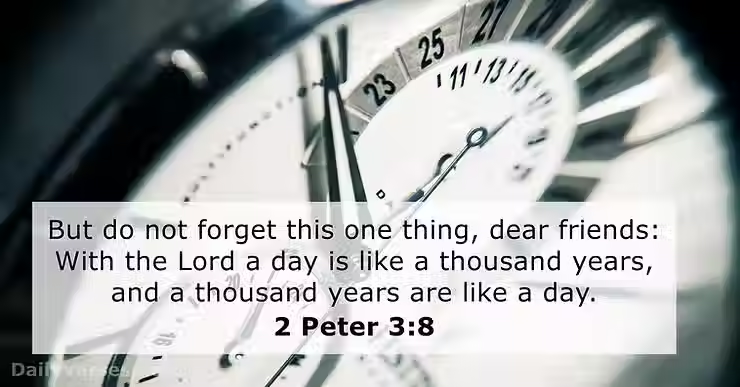
But do not forget this one thing, dear friends: With the Lord a day is like a thousand years, and a thousand years are like a day. The Lord is not slow in keeping His promise, as some understand slowness. Instead He is patient with you, not wanting anyone to perish, but everyone to come to repentance. (2 Peter 3:8-9 NIV)
Time has a peculiar quality. When we're young, summer vacation stretches endlessly before us. As adults, entire years seem to vanish in the blink of an eye. But have you ever considered that time might mean something entirely different to God than it does to us?
This question becomes particularly pressing when we consider the grand narrative of redemption. From the moment sin entered the world in the Garden of Eden, thousands of years passed before Jesus came to offer salvation. Why such a long wait? What about all those people who lived and died before the cross? And why does God sometimes seem to take forever to answer our prayers or intervene in our circumstances?
These aren't new questions. People have been asking them for centuries.
The Relativity of Time
Time is relative in multiple ways. It's relative to our experience—the older we get, the faster it seems to move. Time is like a roll of toilet paper: the closer you get to the end, the faster it goes. The weeks between Labor Day and Christmas drag on endlessly for a ten-year-old but fly by in what feels like days for busy parents.
But time is also relative in relation to the Lord. Second Peter 3:8 reminds us: With the Lord a day is like a thousand years, and a thousand years are like a day. The Living God is called the Ancient of Days. He is eternal, timeless, existing outside the constraints that bind us. Time simply doesn't mean the same thing to Him that it means to us.
Interestingly, even in the early church, believers were already asking, "Why so long?" Second Peter 3:3-4 addresses scoffers who were questioning, "Where is this 'coming' he promised?" This was written around 65 AD—only thirty years after Jesus ascended to heaven. If people were impatient then, imagine how the question has echoed through two thousand years of church history.
When God's Timing Doesn't Match Ours
We impose these same questions onto our personal lives and prayers. Perhaps you've been praying for a prodigal child to come home for twenty years. Maybe you've battled an addiction for a decade, crying out for freedom. Or perhaps you've been waiting for a job, a healing, a relationship to be restored, and the silence feels deafening.
In these moments of waiting, we can almost hear God's gentle response: "Will you trust Me, even if it's taking longer than you think it should? Do you believe I can and will act, even when action is delayed? Will you trust Me, even when My ways are not your ways?"
Isaiah 55:8-9 puts it plainly: "For my thoughts are not your thoughts, neither are your ways my ways,” declares the Lord. “As the heavens are higher than the earth, so are my ways higher than your ways and my thoughts than your thoughts."
Sometimes our impatience implies that we think we could plan things better than God. But our limited perspective cannot comprehend the intricate tapestry He's weaving through history.
What About Those Who Came Before?
One of the most profound questions concerns those who lived before Christ's sacrifice on the cross. Were they simply lost because they lived at the "wrong" time in history?
The answer is beautifully addressed in Hebrews 11, that great hall of faith. The Old Testament saints—Abel, Enoch, Noah, Abraham, Sarah, Moses, and countless others—lived by faith. They survived impossible circumstances and performed miracles by faith. Hebrews 11:39-40 tells us they "were all commended for their faith, yet none of them received what had been promised, since God had planned something better for us so that only together with us would they be made perfect."
They were saved by faith in the promised Messiah, just as we are saved by faith in the fulfilled promise of Jesus. God counted their forward-looking faith as saving faith in Christ. The fulfillment hadn't yet come, but their trust in God's promise was sufficient.
First Peter 3:18-19 even suggests that between His death and resurrection, Christ descended to proclaim victory to the spirits in prison, liberating those who had been waiting in Hades before resurrection had been activated. The Apostles' Creed captures this: "He descended into hell."
Slow Cooker Redemption
Throughout the centuries between Adam and Christ, God wasn't absent or inactive. He was constantly at work, correcting course, preparing the way, orchestrating circumstances. God practices slow cooker redemption, not microwave salvation.
Galatians 4:4-5 declares: "But when the fullness of the time had come, God sent forth His Son, born of a woman, born under the law, to redeem those who were under the law, that we might receive the adoption as sons." (NKJV)
Jesus came in the fullness of time—at just the right moment, when the time was ripe. This speaks to a different understanding of time than mere chronology. The Greeks had two words for time: chronos and kairos. Chronos refers to chronological time—hours, days, months, years, decades, centuries. Kairos refers to the right time, the opportune moment, the season of significance.
God operates by kairos time. Whether we can discern the reason for the timing or not, He acts when the moment is perfectly ripe for His purposes.
The Reason for the Wait
Second Peter 3:9 provides the clearest answer to "why so long?": The Lord is not slow in keeping His promise, as some understand slowness. Instead He is patient with you, not wanting anyone to perish, but everyone to come to repentance.
God's delay is most often His mercy. Instant judgment would leave no room for grace. God waits for His people to turn back to Him. In His prevenient grace, His Holy Spirit works to convict of sin and draw us to Christ. The waiting is an expression of divine patience, an open door for redemption.
Like the father in the parable of the prodigal son, God stands waiting for us to come home. Like Revelation 3:20 describes: Here I am! I stand at the door and knock. If anyone hears my voice and opens the door, I will come in and eat with that person, and they with me.
The Savior stands at the door of our hearts and knocks, wanting to be welcomed in, ready to enter and dine with us. The delay isn't neglect—it's an invitation.
The Question Before Us
The bottom line is this: Will we wait and trust when we are not in control and cannot see the outcome? Will we believe that God's timing, though mysterious to us, is perfect? Will we open the door when He knocks, rather than waiting for circumstances to align with our expectations?
God's delays are invitations to deeper faith, opportunities to choose trust over understanding. Don't delay in responding to Him—even if He seems to delay in responding to you.


